

A note to US-based customers: All Lit Up is pausing print orders to the USA until further notice. Read more
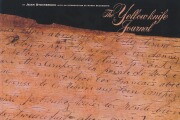

Yellowknife Journal, The
Finding a fur trader?s journal is unusual. Finding a trader?s journal in French is even rarer. Finding a journal in French and written on birchbark is unprecedented. The Yellowknife Journal was kept by Jean Steinbruck, a soldier of German descent who was likely sent to the colonies by a prince as part payment of a debt. Steinbruck accompa nied Alexander McKenzie to the Arctic ocean before working as a fur trader for the North West Company in the Great Slave Lake area. As required by the Company, he kept a journal of his daily trafficking with the natives around his post. In the hard winter of 1802-03, he ran out of paper and was forced to use the birchbark sheets used for patching canoes to keep his daily entries. Historians and collectors have heard of traders resorting to birchbark sheets when they had no paper at their post, but as it was customary for traders to keep a rough journal and then rewrite a fair copy to send in to the company, no other examples of these birchbark journals have survived. In private hands for almost two hundred years, the journal has surfaced thanks to Henry de Lotbiniere Harwood’s passion for Canadiana and his own family’s history. A descendant of the Seigneurs of Vaudreuil and Rigaud, de Lotbiniere Harwood uncovered, preserved and passed on the journal to his children. This unique Canadian artifact has been published as a full-colour facsimile, with accompanying transcription and English translation and a lively and accessible introduction by Harry Duckworth, a noted expert in this field.

“The Yellowknife Journal is a slim, unusual book and a revealing document. Reproduced, page by page, it is an amazing find: a 200-year-old diary written by a fur trader in an elegant hand on fragile birchbark. Risk, riches and intrigue were one side of the traders? lives; sheer physical physical misery through the long winters was another. Losing fishing hooks or breaking an ax could be catastrophic. Other shortages were merely intensely frustrating. Wrote a colleague of Steinbruck?s in his own journal: ?for the future (if the company) expect a Journal will they Please give me Paper to Keep one.? Steinbruck resorted to birchbark when paper ran out just before the winter of 1802 set in. He must have first weighed the danger of using up birchbark strips that were stockpiled for canoe-patching, since there was no more of it for hundreds of miles. That Steinbruck was no Susanna Moodie but a beleaguered trading clerk makes for some plain, sparse reading, but the surprising fact of the diary’s survival in the hands of a private collector and that readers can actually see it, and read it in its original French or its English translation is fuel for the imagination.” The Hamilton Spectator “Fur traders were required to keep journals of their daily lives, their encounters with nature, their trafficking with natives. Jean Steinbruck, at a North West Company post in the Great Slave Lake area, wrote his 1802-1803 notes on birchbark after he ran out of paper. Nuage has published them as a fascinating facsimile copy, in colour no less, complete with French transcriptions and English translations of the daily entries. The Yellowknife Journalis an extraordinary volume, of interest both as an artifact and as a record of the particulars of one man’s winter. Harry Duckworth’s informative introduction provides a larger perspective.”?The Beaver
There are no awards found for this book.
You must be logged in to submit a review.
Details
Dimensions:
64 Pages
8.5in * 10.5in * .2in
280gr
Published:
October 01, 1999
Publisher:
ISBN:
9780921833628
Featured In:
Language:
eng
Share


No author posts found.


