

A note to US-based customers: All Lit Up is pausing print orders to the USA until further notice. Read more
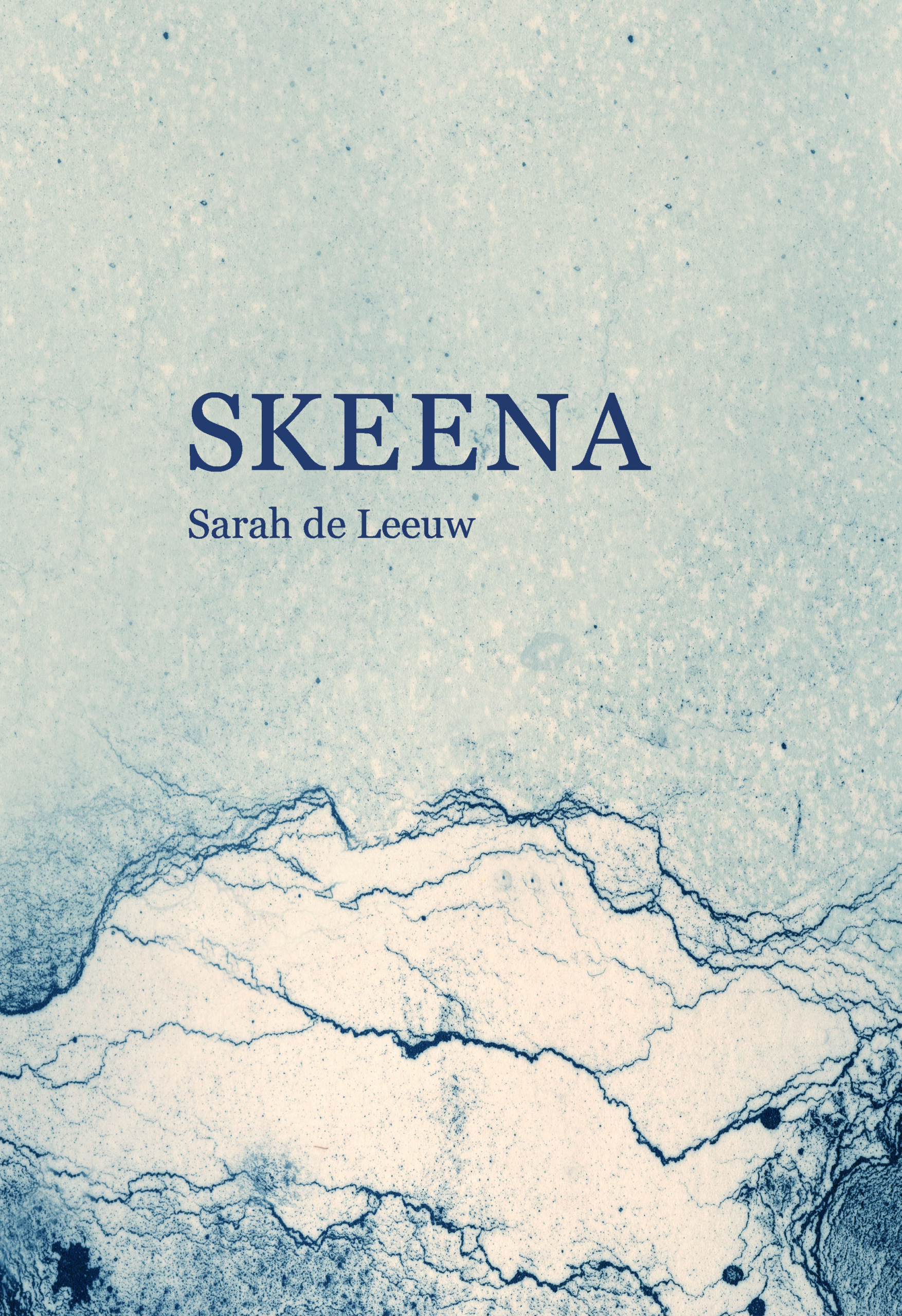
Skeena
An elegy to and celebration of British Columbia’s second-longest river, one at the centre of contemporary conversations about resource extraction and northern geographies, Skeena is an assemblage of voices, stories and histories both about the river and from the river’s perspective. As a single poetic narrative spanning more than ninety pages, this second collection of poetry by award-winning poet Sarah de Leeuw follows a Canadian tradition of long poems, weaving together poetic rendering of the river’s perceptions with archival material that includes highway signs and historical newspapers, scientific reports and local lore, geological surveys and tourist websites. Mirroring a river’s complex tributary structure and rendered in highly concentrated imagistic language and experimental description, Skeena is a poly-vocal watershed of poetry, a book that unflinchingly demands humans understand the power of a river, the life and world of the Skeena River.

“These poems are both songs of joy for the beauty of a river, and prayers for its well being and the well being of all those who dwell within its drainage. The Skeena, the ‘river of mists,’ has its muse in Sarah de Leeuw. This collection is her gift to all of us who know and love a river known to the Tsimshian people as ‘Xsan, the waters that flow from the clouds.'”
–Wade Davis
“De Leeuw documents the river across its history, working with Indigenous knowledges of the place and with texts from the colonial encounter, white settlement, and up to the present, including, for instance, recent scientific studies of the river. Across all of this material, we see the river in its unruly nature, washing away roads and pipelines laid along the shoreline as it pushes against the voices of settlers that would contain or constrain it.”
— Kit Dobson, Canadian Literature
“Sarah de Leeuw’s influences in Skeena are deftly written in and ridden out. Downstream of modernist scrounging and listing, Purdy’s ‘Say the Names’ and the New American form as geography of her spacious phrasing, the confluences are ultimately hers with the river’s—a strong swimmer’s progress into its fecundity, chill, detritus, splendour.”
–John Pass, winner of the Governor General’s Award for Poetry (2006) and The Dorothy Livesay Poetry Prize (2012)
“This is an unusual assortment of discourses which are brilliantly arranged, a collaboration of texts culled from archived newspapers, highway signs, First Nations media; tourism websites, testimonials from locals, chronicles, stories, scientific reports. This much is clear. We are hearing a unique voice and experiencing exceptional visions.”
–Anne Burke, Stanza
“In Skeena, the long poem surges into history, cracks open geology, pushes time itself, maps the length of a river’s habitat into language. Tender and delicate, this poem also pulses with energy visceral enough to perform an extraordinary feat: river as persona flows diaphanous, syllables investigating a complicated and contested space. Ethereal yet concrete enough to hold place names, landscape descriptions, paeans to moon, wolf, and salmon, conversations with that most destructive life-form, human-kind. This is a North Country epic: join the journey de Leeuw creates: a book-length water-saga, uncontainable, a force calling: come, let me take you—”
–Renée Saklikar
There are no awards found for this book.
You must be logged in to submit a review.
Details
Dimensions:
96 Pages
7.91in * 5.40in * .40in
.24lb
160.00gr
Published:
September 14, 2015
Publisher:
ISBN:
9781927575918
Featured In:
Language:
eng
Share


No author posts found.


