

A note to US-based customers: All Lit Up is pausing print orders to the USA until further notice. Read more
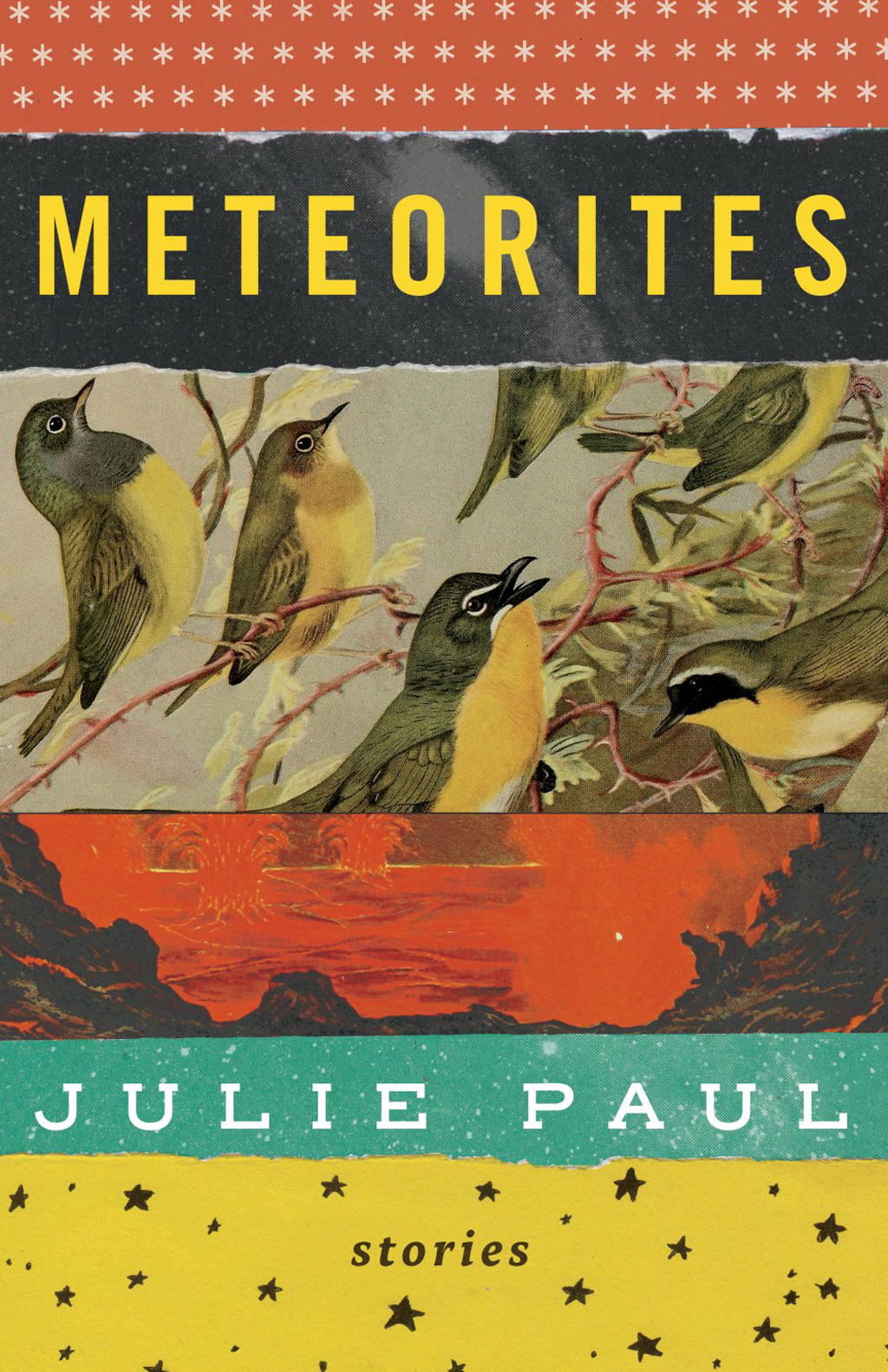

Meteorites
Shortlisted for the 2020 ReLit Award for Short Fiction
A collection of captivating stories that explore family dynamics and frailty, loss and atonement, faith and redemption.
A young man takes his father to Hawaii, even though he’s been dead for months. An organ player won’t let her newly amputated arm stand in the way of Sunday duties. A grad student decides to take the fate of a homeless man into his own hands. A couple of criminals, new to rural living, find their idyllic life in jeopardy when nature strikes back. A stepdaughter moves in, a brother goes missing, and twins fall in love with the same girl. In Meteorites, Julie Paul’s third collection of short fiction, characters are taken by surprise and must react and recover from what’s entered their lives unbidden. Ghosts, giant animals, artists, imposters—you’ll meet them here in these captivating stories of family dynamics and frailty, loss and atonement, faith and redemption.

“In this powerful collection, Julie Paul’s characters wrestle with loss and recovery, reeling from setbacks and rolling with the punches.” —Bustle
“The stories in Julie Paul’s Meteorites assess possibilities for growth in the wake of worst-case scenarios. . . [and] tantalize with the notion that magic might coexist with everyday life.” —Foreword Reviews
“It is the careful attention to . . . intertextual linkages that elevates Meteorites from a group of disparate, individual pieces to an intriguing, unified whole.” —Quill & Quire
“The stories in this entertaining collection are written in the vernacular, the everyday shorthand of family and friends. The content often surprises . . . Fun to read. And check out that gorgeous cover.” —Toronto Star
“These bold, artful stories startle us awake at moments of impact—lives opening to the unforeseen, the inevitable.” —John Gould, author of Kilter: 55 Fictions
“Julie Paul’s genius is for plumbing the quirky, the off-kilter, the fallen, and for unearthing radiant fragments of the acutely human.” —George Sipos, author of The Geography of Arrival
“Julie Paul’s style has a mild, conversational quality reminiscent of Mavis Gallant . . . For readers interested in modern Canadian fiction that portrays the complicated ripples in the lives and relationships of characters struck by unusual circumstances, this is a solid choice.” —Prism“Meteorites is a grab-bag of various delights, whose stories whose concerns include obnoxious step-children, ghosts, teenage friendship, brotherhood, a young daughter’s self-harming, an organist determined to persist after her arm is amputated, and also murder. The settings seem familiar, but something sinister lies at their edges—sometimes surreally so—which is part of what makes these stories such compelling reading.” —Kerry Clare, author of Mitzi Bytes and Waiting for a Star to Fall
“Julie Paul’s third collection, Meteorites, comprises fourteen stories varying in subject matter but often examining intimate relationships, albeit less often in their active state than in the past and seen through the filter of the present.” —Malahat Review
There are no awards found for this book.
You must be logged in to submit a review.
Details
Dimensions:
224 Pages
8.50in * 5.50in * 0.10in
1.00gr
Published:
May 21, 2019
Publisher:
ISBN:
9781927366820
Book Subjects:
Featured In:
Language:
eng
Share


No author posts found.


