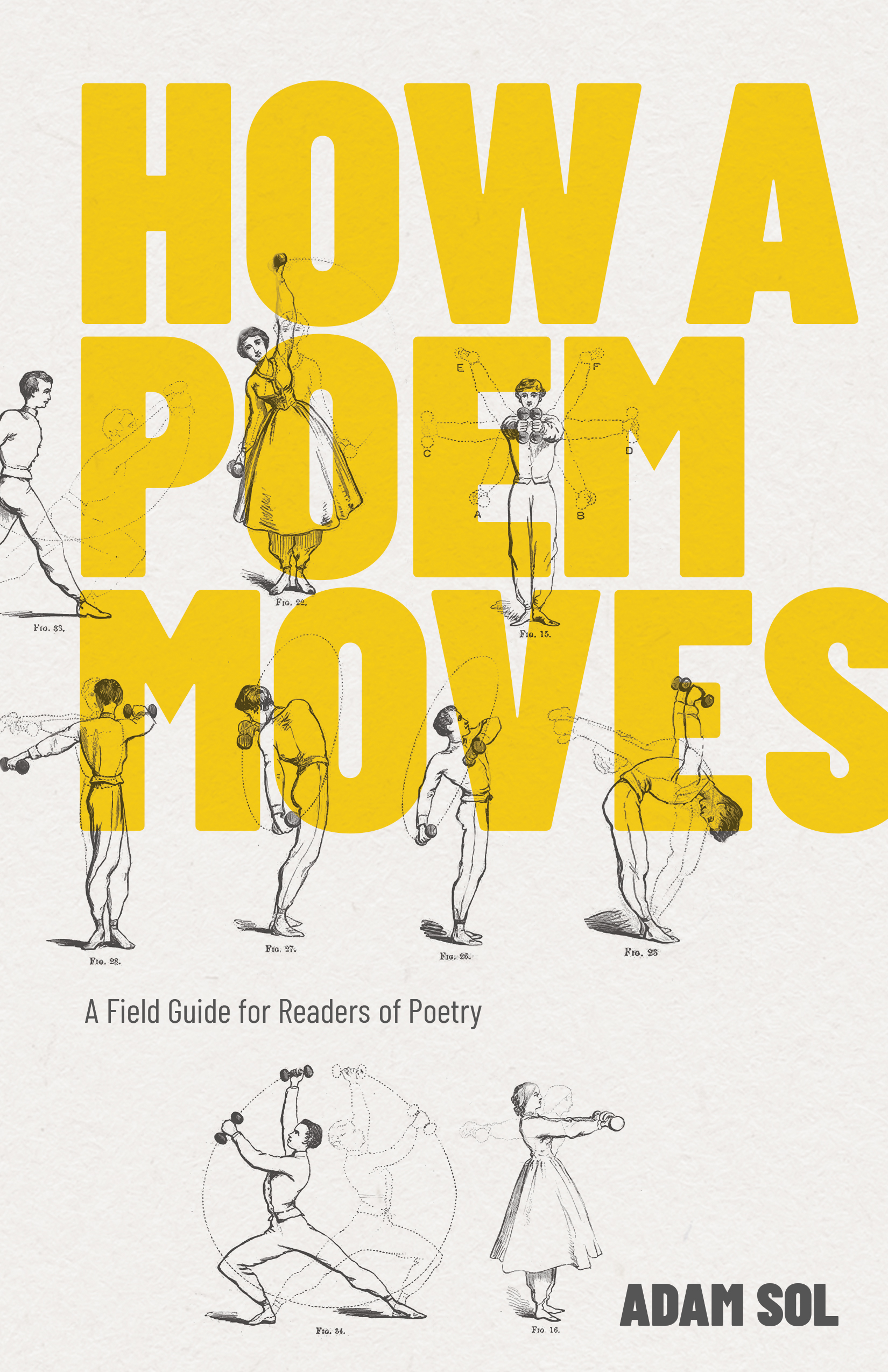
“How a Poem Moves is the perfect antidote to the condition commonly known as Fear of Poetry. And Adam Sol is the perfect companion on this tour of the sounds, sights, and emotional delights of poetry. As someone who’s spent most of her life reading and writing poems, I’m thrilled by Sol’s ability to describe what he loves in a way that teaches me to see it too.” —Tracy K. Smith, U.S. Poet Laureate and Pulitzer Prize−winning author of Life on Mars
“Adam Sol approaches poetry with a unique sensitivity; one that illustrates, with exceptional clarity and insight, just how a poem moves.” — Scott Griffin, founder of the Griffin Poetry Prize
“With an eye to poets of diverse backgrounds and aesthetic modes, and featuring impromptu asides on rhythm and meter, How a Poem Moves is just as at home in the university classroom as the doctor’s waiting room. Sol is a thoughtful and affable guide to ignite — or reignite — a love of poetry.” — Cassidy McFadzean, award-winning author of Hacker Packer
“There is in our wounded world a great need for the balm and challenge poetry can provide. These beautiful, rich, and often surprising meditations get the reader excited about the gift that poems contain… This is a book I will pass out like religious tracts to my friends. I am grateful for it.” — Shelagh Rogers, host and producer at The Next Chapter, CBC Radio One
Developed from Adam Sol’s popular blog, How a Poem Moves walks readers through an array of contemporary poems. Always compassionate and engaging, Sol delivers a collection of thirty-five short essays that are perfect for a quick read or grouped together as a curriculum, demonstrating poetry’s range and pleasures through encounters with individual poems that span traditions, techniques, and ambitions. This illuminating book is for readers who are afraid they “don’t get” poetry but who believe that, with a welcoming guide, they might conquer their fear and cultivate an appreciation for the form.
“This unassuming book provides a great public service — it removes the shroud of mystery that hovers between too many readers and the world of poetry … Sol deserves to be read widely and freely; his humble witness to the simple art of reading may be this book’s most important gift. Libraries should have multiple copies.” —
Library Journal Starred Review
“Going beyond the question of what poems mean, Sol investigates how they work — how they elicit emotion, provide or withhold information, and construct memorable images. His selections, largely derived from his time as a juror for the 2015 Griffin Poetry Prize, tend toward the relatively lesser-known, making this survey equally worthwhile for beginners who can learn from Sol’s instruction and for more seasoned readers who will delight in the new discoveries contained within.” —
Publishers Weekly“One wants to reread the poems, linger over Sol’s arguments …
How a Poem Moves certainly revealed exciting new work to this reader of contemporary poetry, and it evinces the dizzying numbers and varieties of poems produced in North America today. We need more of this kind of thing, and Sol’s project might move more of us to make public our readings as much as poets make public their poems.” —
Quill & Quire“Sol is particularly sensitive to the value of the as-yet-undefined, since giving voice to the contradictory is poetry’s principal strength … But his greatest skill is in underlining the potency of aural effects: He is always on the lookout for alliteration, assonance and consonance, for hidden rhymes and barely-there metres … This is truly a welcoming book — at once an educational snapshot of the contemporary literary scene and a useful example of how to teach for educators themselves.” —
Globe and Mail“It provides a gateway for some of us to discover a new pleasure, and others of us to take a closer look at the poetry we love.” —
Toronto Star