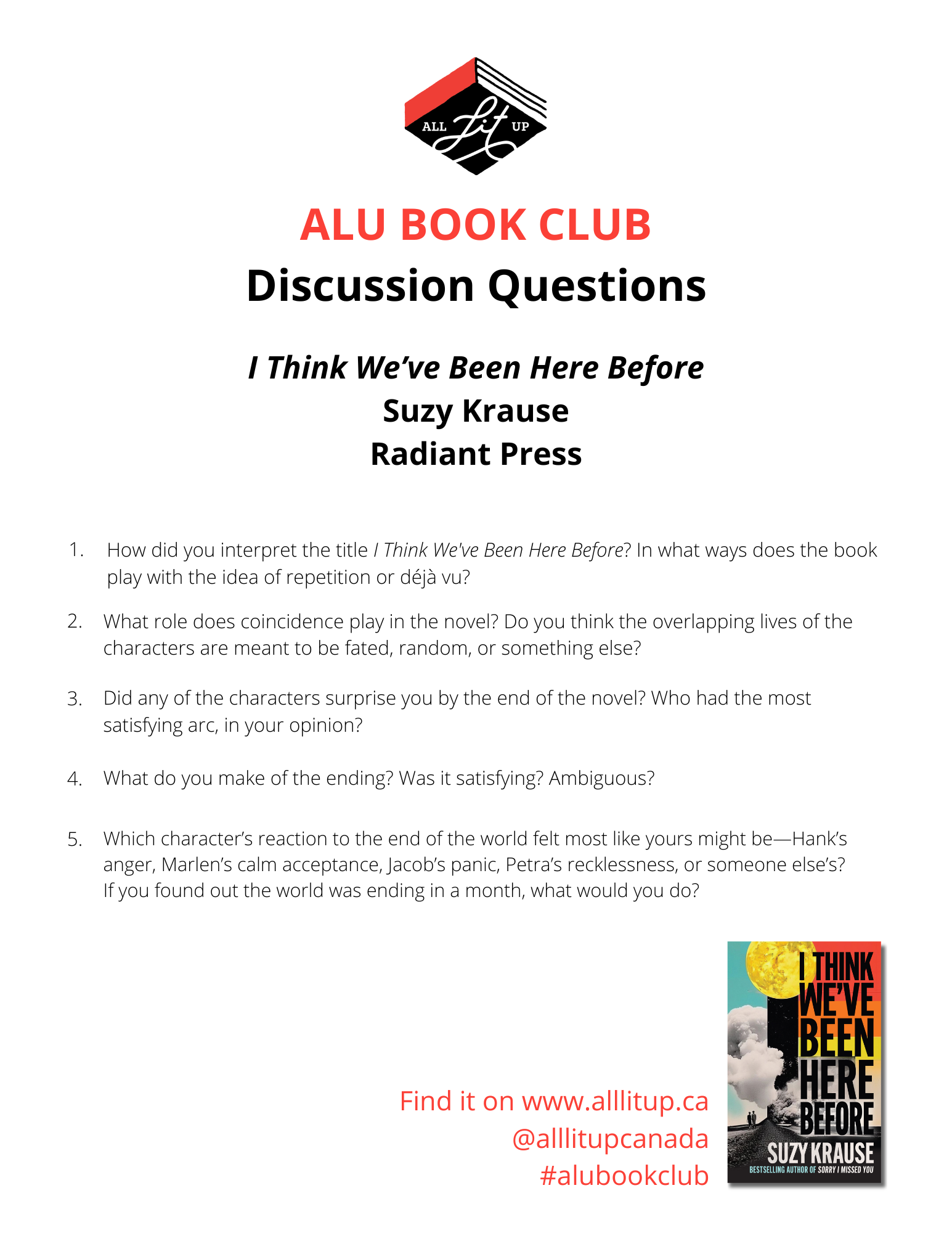
Book club with us and get 15% off I Think We’ve Been Here Before until August 31 with the discount code INTHECLUB2025
I Think We’ve Been Here Before begins with an intriguing premise: what if you knew the end of the world was imminent? In Suzy Krause’s hands, this question opens the door to a tender and thought-provoking story that weaves together the idea of fate, missed connections, and the small mysteries that shape our lives. But this is more than a clever hook—it’s a heartfelt, gently humorous novel about the power of human connection, the possibility of second chances, and what it all means, in the end.
Buy your own copy here on All Lit Up for 15% off (or find a copy from your local indie using our Shop Local finder).
Read on for our team discussion.
* * *
Team Discussion, I Think We’ve Been Here Before
1. How did you interpret the title I Think We’ve Been Here Before? In what ways does the book play with the idea of repetition or déjà vu?
Lauren: I love how this book builds on the idea of déjà vu. It starts out so subtly—with Jacob in chapter one and the cat in chapter two—that the uncareful reader might miss it. And then, as the novel progresses, you see more and more little hints that something is amiss. All of these examples, too, are beautiful: things that unite people and represent their relationships across continents and time.
Tan: The book does a good job setting up this sense of repetition early. Many of the characters felt a sense of deja vu during the story, like most of the major events had already happened. In many cases, this time around, things worked out slightly better than expected. Also, when different characters recount the same events, they sometimes diverge in detail. The cat was an early tell for me that perhaps these lives weren’t all playing out at the same time. He was both at home and in Berlin.
Mandy: The story leans into repetition: missed connections, cycles of fear, repeated mistakes, and even global disasters that seem to come back around. There’s a haunting quality to how the characters feel like they’re living the same lives over and over, but maybe this time, they might break out of the loop.
Laura: The characters experience déjà vu during certain key events, like when Nora first meets Jacob and he seems already to be an intimate of hers. Marlen writing a book about the thing that threatens to kill them all, before it happens, is another example. There are recurring patterns of thought and memory, too, which emphasize the strange loops that fuel this novel. The cat’s appearance in multiple places, against the laws of physics, is another way that images and experiences seem to recur.
Colleen: To me, the novel plays with themes of repetition and déjà vu to illustrate the interconnected nature of the characters, their lives, and their communities. Throughout the story, the characters often feel as if they have experienced what is happening before, both on small and large scales; for example, Nora and Jacob feel as though they have already met, characters feel they’re repeating conversations, and they’re often not surprised by the outcomes of what they experience. These similar and shared moments, although small, pose a meaningful example of connectivity and shared experience.
2. What role does coincidence play in the novel? Do you think the overlapping lives of the characters are meant to be fated, random, or something else?
Tan: I like the idea of characters being entangled, meant to come back to each other through time. I liked that characters often cherished the same shared memories of each other, without understanding the shared significance. (Like Ole and Irene, remembering their trip to the city and crossing the street; the silver locket.)
Laura: I loved the multi-POV structure of this novel, which allows readers to move around with different characters. This helps us see the overlaps in their perceptions, and of course, they are a family, so their lives are interwoven already. Without spoiling anything, Iver’s interpretation of Ole’s arrival, through a memory from the past, helps us see that the frame of interpretation is everything. You can take joy in every circumstance, it seems. A central question of the novel is fate versus randomness, as the characters grapple with what’s going to happen, and what really matters to them when not much time is left.
Mandy: Coincidence is everywhere in the novel, and the line between chance and fate is intentionally blurred. The characters cross paths in ways that feel too pointed to be purely random, yet the book avoids fully endorsing fate. Instead, it feels like Krause is exploring how small moments and choices ripple outward.
Colleen: Coincidence plays a significant and constant role in the novel. I think the overlapping lives of the characters serves to solidify the characters’ belief in quantum entanglement, as seen in the separate conversations where Nora and Jacob, and Hilda and Marlen, explain it to each other to ease their anxieties about being apart during the end of the world. Coincidences throughout the novel also helps to solidify the ending, bringing feelings of peace by showing that the characters don’t die when the world ends; instead, they are simply reliving their lives, becoming more interconnected with each iteration.
3. Did any of the characters surprise you by the end of the novel? Who had the most satisfying arc, in your opinion?
Lauren: I really loved Hank and Irene’s arc; that they put their differences of opinion aside to acknowledge that they were both afraid, and afraid for their son Ole missing, too. Their relationship started out so rocky and ended quite tender.
Tan: I loved Iver discovering that he can still make amends, still learn new things, still matter to his family. Appreciated Alfie’s role, and that she found her family/was loved in the end.
Colleen: Although many of the characters demonstrate considerable growth by the end of the novel, I found Hilda’s arc the most satisfying. By the end, she comes to terms with her loss of control over nearly all aspects of her life—her dying husband, her daughter living abroad, her relationships with her family, and the approaching apocalypse. She learns to accept these things while also finding joy and peace by exerting control where she can, such as painting murals in their home.
4. What do you make of the ending? Was it satisfying? Ambiguous?
Lauren: Without saying too much about the ending to spoil it, it was so satisfying that I had tears rolling down my cheeks, and a heart full of hope (no small feat; this is a book about the apocalypse, after all!).
Mandy: It’s less about what happens and more about how the characters choose to face what’s happening. The ending doesn’t hand us all the answers—life isn’t neatly resolved, especially in the face of something as unknowable as the end of the world.
Colleen: I loved the ending! Marlen’s explanation of reliving our lives when/before we die added an incredible layer of context to the rest of the novel, explaining the elements of déjà vu and why the characters often found people or moments familiar. It confirmed the interconnectedness of the narrative, making it clear that this was not the first time the characters had relived their lives, and it exemplifies the novel’s exploration of quantum entanglement—each time the characters relive their lives, they become more interconnected, having similar thoughts, ideas, and experiences despite their different environments and circumstances.
Tan: It was a nice way to think of what’s happening.
5. Which character’s reaction to the end of the world felt most like yours might be—Hank’s anger, Marlen’s calm acceptance, Jacob’s panic, Petra’s recklessness, or someone else’s? If you found out the world was ending in a month, what would you do?
Mandy: Some combination of quiet acceptance and impulsive action. The novel really makes you wonder: how would you live differently if you truly felt the clock ticking?
Laura: If I found out the world was ending in a month, I’d revise my magical thinking about getting through my TBR pile.
Tan: It might be Nora’s reaction: To go with it all, get the most (out of the) time with the people I love as I can. To forget/ignore when you can, so that you can cherish what you have.
Colleen: I think my reaction would be a mix between Jacob’s panic and Petra’s recklessness. If I found out the world was ending, I would absolutely panic, but once that was over, I’d like to think I’d make the best out of the end of the world by spending as much time as possible with my loved ones, and checking off things from my bucket list.
Lauren: I think I’m an Alfie—keep myself busy working on many different things, right up until the end.
* * *
* * *
Get I Think We’ve Been Here Before for your own book club here on All Lit Up for 15% off with the code INTHECLUB2025, all summer long.
Keep on top of all summer book club happenings here.